

At SanWild, conservation means...
Injured animals recover and return to the wild.
Resident animals live in natural surroundings.
Endangered species roam free and protected.
Humans take responsibility for the outcomes.
There is no truly open wilderness left in South Africa. Wildlife now lives within fenced reserves and national parks, where protection and management are essential.
SanWild staff and Scout Ranger Volunteers focus on a wide range of activities...
Active conservation

SanWild is a working wildlife sanctuary focused on daily operations, animal care, and active, on-the-ground conservation.
Scout Ranger Volunteers are part of this work. Tasks include maintaining enclosures, assisting with animal care, and supporting field activities across the reserve. Each day is shaped by operational needs.
Where possible, injured and orphaned wildlife are rescued, rehabilitated, and prepared for release. Our efforts prioritise recovery, stability, and the preservation of natural behaviour. Human bonding is avoided, and release takes place only when it is safe for the animal.
Rescues, translocations, and veterinary interventions are not scheduled. They occur as needed and cannot be predicted. When they do, volunteers may be involved as part of the team. These moments are not guaranteed.
The Scout Ranger Volunteer programme remains centred on the consistent, day-to-day running of the sanctuary.
Protecting cheetahs

We are part of a national cheetah breeding and reintroduction programme, with free-roaming cheetahs closely monitored.
We collaborate with the Cheetah Metapopulation Project, Endangered Wildlife Trust, and Cheetah Advisory Group to grow populations and reintroduce cheetahs to areas where they are locally extinct. In 2017, three SanWild cheetahs were relocated to Liwonde National Park in Malawi, where a small population is now re-established.
More recent work includes bonding two unrelated adult males into an alliance, now released onto the greater SanWild sanctuary where they hunt independently.
All cheetahs are fitted with GPS collars and tracked several times weekly by staff and volunteers to monitor health, movement, hunting success, and breeding - essential given risks such as injury or larger predators.
As part of a managed metapopulation, offspring are relocated to strengthen other reserves, guided by genetic management for long-term viability.
Volunteers support tracking, data collection, and field observation, contributing directly to on-the-ground conservation.
Large predator care

SanWild is home to a number of lions and hyenas that cannot be released back into the wild.
These animals are human imprinted, meaning they do not have a natural fear of people. A lion that has lost that instinct behaves differently and can pose a serious risk, making release unsafe.
Many of our lions have been rescued from circuses, zoos and the illegal wildlife trade, arriving from countries such as France, Hungary and Lebanon. These rescues are made possible through partnerships with organisations including Tonga Terre d’Accueil, Animals Lebanon, the Brigitte Bardot Foundation, 30 Millions d’Amis and One Voice.
At SanWild, these animals cannot be fully released, but they do get space. Predator enclosures are large and natural, up to 8 hectares, allowing them to move across bushveld, hills, forest and grassland, and live in an environment that closely resembles their natural habitat.
These predators require ongoing care and responsible management. Volunteers assist with maintaining these areas and supporting the team in monitoring health, nutrition and behaviour.
The focus is always on the wellbeing of the animal. No handling. No interaction. No display.
Rhino conservation

SanWild is home to free-roaming white rhinos. These endangered animals are monitored regularly to track movement, behaviour, and overall wellbeing, allowing risks to be identified early and maintaining a high level of protection.
Without horns, rhinos have little value to poachers. For this reason, all of our rhinos are dehorned at regular intervals. We do not take this step lightly, but it remains one of the most effective ways of reducing poaching risk.
The procedure is painless, comparable to trimming a fingernail, and is carried out by qualified wildlife veterinarians under permit, with the Department of Nature Conservation present for oversight and DNA sampling. As the horn regrows, the process is repeated approximately every 24 months.
Each rhino is fitted with tracking technology. Staff and volunteers monitor them regularly in the field to check their condition and ensure their safety as part of the broader protection strategy.
SanWild does not support the legalisation of the rhino horn trade. The focus remains on protecting wild populations and reducing demand.
Through sustained conservation efforts, the rhino population at SanWild has grown significantly over time.
Landscape restoration

Healthy wildlife depends on healthy land. At SanWild, restoring the landscape is part of the daily work.
The ground of today's sanctuary was once used for cattle farming. Overgrazing, combined with the loss of natural species like elephants, led to a decline in grasslands and the spread of invasive bush. Some areas were also affected by soil erosion.
Today, we work to reverse this.
Overgrown areas are cleared to allow sunlight back to the soil so natural grasslands can recover. Degraded land is stabilised using structures such as gabions to slow water flow and prevent erosion.
Invasive plants are removed. Water points are maintained. Snares are cleared.
SanWild is also home to rare and endangered plant species, which are actively protected.
The goal is simple: To restore a balanced, functioning ecosystem where wildlife can thrive.
Anti-poaching patrols
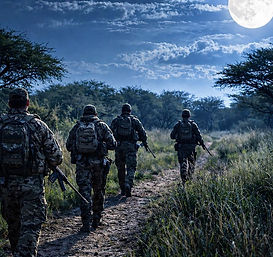
Poaching is a reality across wildlife reserves, particularly for species such as rhino. At SanWild, protection forms part of the daily work on the ground.
Our approach combines prevention and monitoring. Fences and access points are maintained, patrols are carried out, and signs of intrusion are checked regularly. All rhinos are dehorned to reduce risk and fitted with tracking devices, allowing real time monitoring.
Volunteers support this system through practical tasks. This includes setting up and monitoring camera traps, tracking animals using GPS technology, and assisting with maintaining a clear overview of activity across the reserve.
When breaches occur, professional counter poaching units respond. Volunteers are not involved in these operations and are never placed in danger.
On the ground, volunteers also assist with regular snare sweeps, removing traps before any animal is harmed. These activities are carefully managed and form part of ongoing preventative conservation work.
Poachers generally avoid people and do not seek confrontation. Their aim is to remain undetected. Our role is to identify activity early and respond through the appropriate channels.